Discover the top Cross Platform Mobile App Development Services of 2026. Compare costs, frameworks, timelines, and vetted providers—then start your MVP fast.

Launching an app on a single platform is no longer enough to win. With Android commanding roughly 71% to 73% of the global mobile OS market and iOS holding the rest, reaching both audiences from day one is the default for founders who want to maximize their addressable market.
Cross platform mobile app development services have become the strategic choice for startups and businesses that prioritize speed, budget efficiency, and a unified user experience. This approach uses a single codebase to ship apps to both iOS and Android simultaneously, dramatically cutting down on development time and costs. For founders on a tight runway, this means validating ideas and reaching product market fit faster.
If you’re looking for a founder friendly partner that delivers high quality apps in weeks, not months, see how the design led team at Bricks Tech builds and ships MVPs in 4 to 8 weeks.
What is cross platform app development?
Cross platform app development is an approach that allows developers to write code once and run it on multiple operating systems, primarily iOS and Android. Instead of building two separate native apps, a cross platform service provider uses a shared codebase, native UI access, and a continuous integration and delivery (CI/CD) pipeline to target both the Apple App Store and Google Play Store.
Common strategies include sharing both the user interface (UI) and business logic, sharing only the business logic while building native UIs, or sharing specific modules. The ecosystem is mature, with frameworks and tools that provide extensive access to native device features like the camera, GPS, and secure storage.
For a guided path from idea to a shipped build, the Bricks Tech team can scope, design, and develop your app end to end, then hand off complete ownership at launch.
Cross platform vs native, what to expect
Both cross platform and native development are valid strategies. The best choice depends on your specific goals, timeline, and budget.
Where cross platform shines
Faster time to market: Deliver iOS and Android versions in parallel using one primary codebase, cutting development time by up to 40%.
Cost efficiency: A single codebase reduces duplicate work, allowing a smaller team to build and maintain the app, which can lower costs by 30% to 40% compared to native builds.
Consistent user experience: A shared UI ensures your brand and user flows are consistent across all devices.
Simplified maintenance: Updates and bug fixes are deployed to both platforms from one codebase, streamlining the maintenance process.
Where native can still win
Peak performance: For graphically intense applications like high end games or apps with heavy sensor processing, native code can offer performance advantages.
Deep platform integration: When an app relies heavily on the latest OS specific features or deep system customizations, a native build provides the most direct access.
Large, established teams: Companies that already have separate, scaled teams for iOS and Android may find it practical to continue with their existing native stacks.
Cross platform services are the preferred choice for most startups and businesses focused on speed and early growth. They offer the ideal balance of performance, cost, and reach for validating ideas and scaling a user base.
Popular frameworks and languages used by service providers
An experienced development partner will select the right tool based on your product requirements, team skills, and long term goals. Here is a look at the leading cross platform frameworks.
React Native (JavaScript and TypeScript)
Backed by Meta and a massive open source community.
Ideal for teams with existing React and web development expertise.
Used extensively in Meta’s own apps, proving its capability for complex and high performance applications.
Flutter (Dart)
Developed by Google, it renders its own UI for a pixel perfect, consistent look across platforms.
Known for its expressive UI and fast development cycles. According to 2026 data, 46% of developers globally use Flutter for cross platform apps.
Strong adoption across developer surveys and a growing ecosystem of packages.
Kotlin Multiplatform (Kotlin and Compose Multiplatform)
Allows teams to share business logic across Android, iOS, and other platforms while retaining the option for native UIs.
Gaining significant traction, with usage more than doubling among developers in recent years.
Offers the flexibility to share as much or as little code as needed.
.NET MAUI (C Sharp)
The evolution of Xamarin, this framework is best for teams already invested in the Microsoft and .NET ecosystem.
With Xamarin support officially ending on May 1, 2024, .NET MAUI is the clear migration path for C# developers.
Web plus native bridges (Capacitor or Tauri)
Excellent for content driven or form based apps, especially when a responsive web app already exists.
Wraps a web app in a native shell to provide app store distribution and access to some device features.
An experienced partner will recommend the right blend of shared code and native modules to deliver the best balance of speed and user experience.
How we selected the top cross platform development companies
To help you find a reliable partner, we evaluated dozens of service providers based on a transparent methodology focused on what matters most to founders:
Proven track record and client results: We looked for agencies with a public portfolio of successful app launches and positive, verifiable client reviews on platforms like Clutch.
Founder focused process: The best partners think like founders. We prioritized firms that offer transparent, design first processes, weekly demos, and clear communication channels.
Technical expertise and modern stack: We selected companies with demonstrated expertise in leading frameworks like React Native and Flutter, as well as experience with modern backends (e.g., Supabase, AWS) and API integrations.
Speed and efficiency: We favored providers with a documented ability to deliver MVPs in a matter of weeks, not months, often through structured programs or sprints.
Transparent pricing and engagement models: The list includes partners who offer clear, upfront pricing, flexible engagement models (fixed scope, retainers), and risk reducing offers like a refundable first week.
Top 6 Cross Platform Mobile App Development Services
This shortlist highlights six service partners specializing in delivering a single codebase for iOS and Android without compromising user experience. These firms are recognized for their proven results and end to end capabilities.
1. Bricks Tech
Bricks Tech is a founder focused product studio that ships cross platform apps fast using a pragmatic no code and low code stack. Their design first approach, which blends Bubble for the app layer and Supabase for the backend, helps startups in fintech, e commerce, and social networking get to market in 4 to 8 weeks.
Quick Facts: Location: Toronto, ON, Canada | Employees: 11 to 50
Highlights:
Ideal for: MVPs in 4 to 8 weeks; a scoped eight week discovery to app track keeps founders on budget.
Collaboration: A pod model with a PM, designers, and developers ensures weekly checkpoints and crisp release notes.
Velocity: A powerful Bubble and Supabase stack with over 100 API and AI integrations; responsive 24 hour support.
Ownership & Handoff: Clean documentation and founder friendly playbooks are provided post launch.
Services:
Cross platform MVPs using Bubble and Supabase.
UI/UX design, prototyping, and Figma wireframes.
API and AI integrations (Stripe, Google Maps, ChatGPT, Claude).
App store releases, CI/CD, and ongoing maintenance.
Explore recent projects to see what this looks like in practice.
2. Space O Technologies
Space O is a seasoned cross platform partner that pairs React Native and Flutter expertise with design led discovery and agile delivery. Their two week sprints and clickable prototypes help founders in healthcare, finance, and logistics ship MVPs quickly.
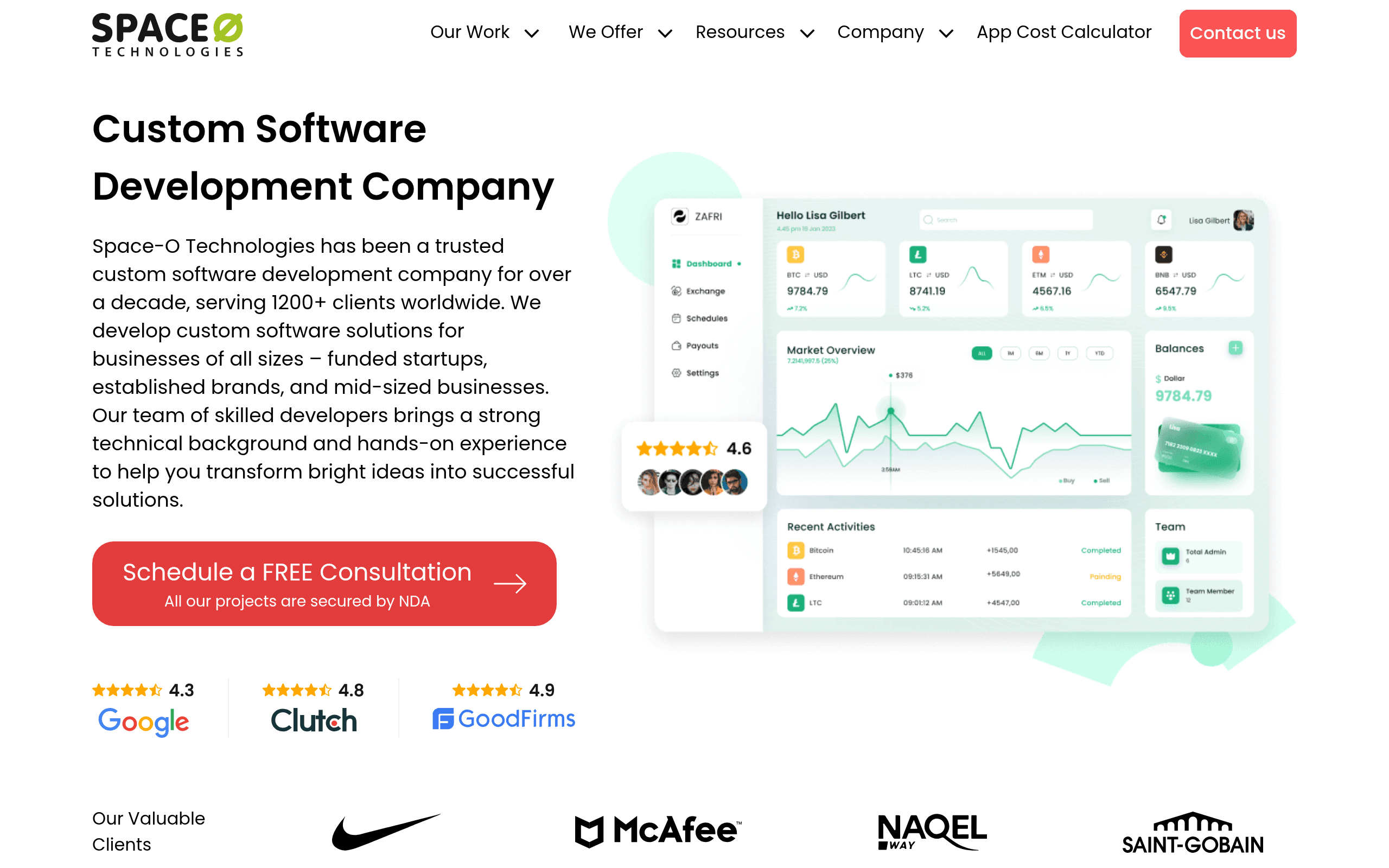
Quick Facts: Location: Tempe, AZ, USA | Employees: 51 to 200
Highlights:
Predictable delivery: Two week sprints with demos and prioritized backlogs.
Proven results: Featured apps like Glovo (“Best of 2016”) and strong healthcare case studies.
Compliance: ISO 9001/27001 certified and experienced with GDPR/HIPAA.
Founder friendly: Flexible models to maximize code reuse and speed.
Services:
Cross platform development in React Native, Flutter, and Xamarin.
UI/UX wireframing and usability studies.
App modernization and AI integrations.
Cloud deployment on AWS, Azure, and Google Cloud.
3. RipenApps Technologies
RipenApps brings specialized squads for Flutter and React Native to deliver cross platform builds with research led UX. With a global presence, they help founders validate ideas fast across education, healthcare, and fintech.
Quick Facts: Location: Ontario, CA | Employees: 100 to 249
Highlights:
Ideal for: MVPs in 4 to 12 weeks, from prototypes to internal tools.
Proof: Apps with over 500K+ downloads and high user ratings.
Collaboration: Dedicated project managers and transparent sprint planning.
Support: Flexible squads and ongoing optimization post launch.
Services:
Cross platform builds using Flutter, React Native, Ionic, and Xamarin.
UI/UX research and prototyping.
API, payment, and AI/ML integrations.
CI/CD pipelines and cloud maintenance.
4. Closeloop Technologies
Closeloop blends Silicon Valley product thinking with global execution to deliver robust cross platform apps in Flutter and React Native. Their milestone based budgets and test driven development (TDD) approach appeal to founders in logistics, retail, and edtech.
Quick Facts: Location: Mountain View, CA | Employees: 100 to 249
Highlights:
MVP pace: Agile sprints with many builds starting near $50K for clear early traction.
Credibility: A 5.0/5.0 rating on Clutch and Inc. 5000 recognition.
Engineering depth: Expertise in AWS, Azure, GCP, and offline first patterns.
Proof: A portfolio of enterprise grade deliveries for clients like Tailored Brands.
Services:
Cross platform apps with Flutter and React Native.
Native iOS and Android development when needed.
UI/UX design and API integrations.
AI, IoT, and comprehensive QA testing.
5. Glorium Technologies
Glorium is a U.S. based, full cycle product studio known for secure and compliant cross platform builds using Flutter, React Native, and Kotlin Multiplatform. They are a strong choice for founders in regulated industries like healthcare and real estate.
Quick Facts: Location: Princeton, NJ | Employees: 201 to 500
Highlights:
Time to market: MVPs in 4 to 8 weeks, from discovery to soft launch.
Trust & compliance: ISO certified, HIPAA/FHIR experience, and an AWS Select Tier partner.
Founder experience: Design first workshops and clear roadmaps to reduce risk.
Proof: Strong reviews and repeat clients in healthcare and real estate.
Services:
Cross platform development with Flutter, React Native, and Kotlin Multiplatform.
UI/UX design and MVP roadmapping.
API integrations and optional AI features.
Cloud deployment, maintenance, and DevOps.
6. Xavor Corporation
Xavor is a U.S. headquartered engineering partner delivering user first cross platform apps with Flutter and React Native. Their design led discovery and strong DevOps pipelines are ideal for founders seeking velocity without platform lock in.
Quick Facts: Location: Irvine, CA | Employees: 51 to 200
Highlights:
Ideal for: MVPs in 4 to 8 weeks, lean budgets, and internal tools.
Proof: Modernized processes for Virgin Entertainment Group, saving 40 to 50 hours weekly.
Collaboration: Dedicated PMs and clean ownership handoffs.
Security & scale: DevSecOps, OWASP practices, and AWS/Azure expertise.
Services:
Cross platform apps in Flutter and React Native.
Migrations and modernization of legacy apps.
Conversational and agentic AI integrations.
IoT and wearables integration.
Side by Side Vendor Comparison
Service Provider | Ideal For | Key Technologies | Estimated MVP Price | Location |
|---|---|---|---|---|
Bricks Tech | Founders needing an MVP in 4 to 8 weeks | Bubble, Supabase, n8n, AI | $10,000 | Toronto, ON |
Space O Technologies | Startups in regulated industries (healthcare, finance) | React Native, Flutter | Custom | Tempe, AZ |
RipenApps | Validating ideas on a lean budget | Flutter, React Native, Ionic | Custom | Ontario, CA |
Closeloop | Enterprise grade MVPs | Flutter, React Native, AWS | Starts near $50,000 | Mountain View, CA |
Glorium Tech | Secure and compliant builds (HIPAA, ISO) | Flutter, React Native, KMP | Custom | Princeton, NJ |
Xavor Corp | Lean budgets and internal tools | Flutter, React Native, Azure | Custom | Irvine, CA |
Understanding costs: pricing for cross platform app development
Budgeting for an app can be challenging because complexity is the primary cost driver. A simple utility app is vastly different from a multi sided marketplace. However, cross platform development is inherently more cost effective.
Here are typical cost brackets for 2026:
Simple Apps & MVPs ($30,000 to $80,000): These apps have basic functionality, 5 to 10 screens, and a standard UI, making them ideal for testing a core business idea.
Mid Complexity Apps ($80,000 to $250,000): This range typically includes apps with custom UI/UX, user accounts, API integrations, and payment gateways, such as e commerce or social apps.
Complex, Feature Rich Apps ($250,000+): These are applications with advanced features like real time data, AI/ML integrations, and extensive backend infrastructure.
A key takeaway is that cross platform frameworks can reduce development costs by 30% to 40% compared to building two separate native apps. Additionally, remember to budget for ongoing maintenance, which typically costs 15% to 20% of the initial development budget annually.
How to choose a cross platform app development provider in the US
Selecting the right partner is critical for US startups where speed and validation are everything. Look beyond the portfolio and evaluate how a provider operates.
Look for a founder focused mindset
Your development partner should think like a founder. They should understand budget and timeline constraints and focus on building the core features that test your hypothesis, not over engineering a solution. An agency that challenges your assumptions and prioritizes your business goals is an invaluable asset.
Prioritize a design first, transparent process
Avoid surprises by choosing a team that prioritizes a design first workflow. Seeing high fidelity wireframes in a tool like Figma before development begins ensures everyone is aligned. Insist on a process with weekly demos and clear communication so you can provide continuous feedback.
Evaluate their tech stack for speed and scale
A modern tech stack can dramatically accelerate development. Ask about their experience with low code platforms like Bubble for MVPs and their expertise in integrating with essential third party APIs and AI tools like ChatGPT or Claude.
Check for clear scoping and risk reduction
The best partners reduce risk. Look for providers that offer fixed scope packages with transparent pricing and timelines. A strong signal of a confident partner is a trial period or a refundable first week of development, which allows you to test the relationship before committing fully.
Consider global teams for quality and cost efficiency
Many successful US startups partner with agencies that have a global footprint. A model that combines US based leadership with a global technical team can offer the perfect blend of high quality communication, strategic oversight, and cost efficiency.
Key considerations for a successful launch
Beyond choosing a partner, several technical and procedural factors are crucial for a smooth launch and long term success.
Security, privacy, and compliance checklist
Security is not an afterthought. From day one, ensure your development partner follows best practices:
Data Encryption: All data, both at rest and in transit, should be encrypted using strong standards like AES 256 and SSL/TLS.
Secure Authentication: Implement multi factor authentication (MFA) and use secure protocols like OAuth 2.0.
API Security: Protect APIs with token based authentication and rate limiting to prevent abuse.
Regular Audits: Conduct frequent security testing, including penetration testing and code scanning, to identify and fix vulnerabilities.
Compliance: Ensure the app complies with relevant regulations like GDPR, CCPA, and HIPAA, especially if you handle sensitive user data.
App store compliance and release management
Getting your app approved by the Apple App Store and Google Play Store requires careful planning. Key differences include:
Review Process: Apple uses a manual review process that is typically more stringent, while Google’s is largely automated.
Approval Time: Apple’s review can take 24 to 72 hours, whereas Google’s can range from a few hours to seven days.
Guidelines: Both stores have detailed guidelines covering everything from design and metadata to privacy and monetization. Familiarize yourself with Apple’s App Review Guidelines and Google’s Developer Program Policies.
A pre submission checklist should include verifying that screenshots are accurate, privacy policy links are working, and all features have been thoroughly tested.
Maintenance, SLAs, and post launch support
Launching an app is just the beginning. A good partner will offer a clear maintenance plan to handle:
Bug Fixes and Updates: Proactive monitoring and bug resolution.
OS Compatibility: Updating the app to work with new versions of iOS and Android.
Security Patches: Applying updates to protect against new vulnerabilities.
Service Level Agreements (SLAs): Formal agreements that define response times for issues based on their severity.
Ongoing maintenance is critical for user retention and protecting your investment.
Advanced topics and future trends
Offline first architecture
An offline first app is designed to work without an internet connection. By storing data locally and syncing with a server when a connection is available, these apps provide a seamless and reliable user experience, even with spotty connectivity. This approach improves performance, reduces server load, and is crucial for apps used in environments with unreliable internet, such as logistics or field service.
Is a Progressive Web App (PWA) a better alternative?
A Progressive Web App (PWA) is a web application that functions like a mobile app. It can be accessed through a browser and installed on a user’s home screen without visiting an app store.
When to choose a PWA:
You need broad reach, fast deployment, and cost efficiency.
Your app is content driven, like a blog or e commerce site.
Bypassing app store approvals is a priority.
When to choose a cross platform app:
You need deep device integration and access to native hardware features.
Peak performance is critical for your app’s core functionality.
You want the visibility and distribution benefits of the app stores.
The right choice depends on your business goals, budget, and required features.
Conclusion
For most startups and fast moving businesses, cross platform mobile app development services provide the fastest, most budget friendly path to launching on both iOS and Android. The global market split, the rise of AI features, and the maturity of modern frameworks all make a strong case for a single, shared roadmap. This approach allows you to validate your product, gather user feedback, and grow your business efficiently before making deeper platform investments.
If you want a clear plan, weekly demos, and a build in 4 to 8 weeks, start a free consult with the product team at Bricks Tech.
FAQ
What are cross platform mobile app development services?
They are end to end offerings that design, build, and ship a mobile app to both iOS and Android from a single shared codebase. This approach uses frameworks like React Native or Flutter to accelerate development and reduce costs.
How much does it cost to build a cross platform app?
The cost depends on complexity. A simple MVP might cost between $30,000 and $80,000, while more complex apps can range from $80,000 to over $250,000. Using a cross platform approach can save 30% to 40% compared to building two separate native apps.
Are cross platform apps slower than native?
For most applications, like social feeds, e commerce stores, and productivity tools, modern cross platform frameworks can perform on par with native apps. Only in cases of extreme graphic or sensor processing might native have a noticeable advantage.
How long does it take to build an MVP?
With a focused agency and a modern tech stack, an MVP can be built in as little as 4 to 8 weeks. This accelerated timeline is one of the key benefits of cross platform development.
How do I ensure my app is secure?
Partner with a provider that follows security best practices like data encryption, secure authentication, API protection, and regular security audits. Ensure they are familiar with compliance standards like GDPR or HIPAA if they apply to your business.
Why partner with Bricks Tech for a cross platform build?
You get a design first process, high fidelity Figma wireframes before development, weekly demos, and an eight week “Build From Scratch” package with a fully refundable first week. The process is tailored for founders who need to move fast without sacrificing quality. Learn more at Bricks Tech.